
Breaking Generational Patterns: Rewriting the Story You Inherited

A practical toolkit for recognizing patterns, creating change, and challenging mental health stigma

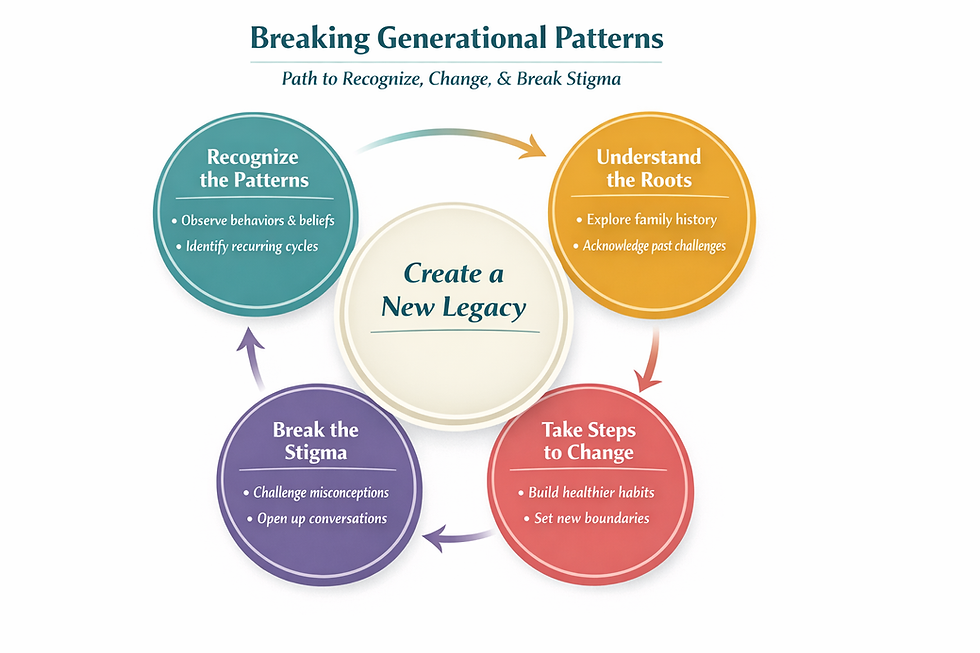
Generational patterns, sometimes referred to as “generational curses,” are deeply rooted behaviors, beliefs, and emotional responses passed down through families over time. These patterns often develop as ways to cope, survive, or adapt to circumstances. While they may have served a purpose in the past, they can feel limiting, confusing, or even harmful in the present.
This toolkit is designed to help you identify these patterns, understand where they come from, and take meaningful steps toward change, while also addressing the stigma that can make these conversations difficult to have.
1. Understanding Generational Patterns
Not all generational patterns are negative, but the ones that feel restrictive often go unspoken. They show up in subtle, everyday ways, such as how emotions are expressed, how conflict is handled, or what is considered “normal” within a family.
|You might notice patterns such as avoiding difficult conversations, minimizing emotions, normalizing stress or burnout, or holding beliefs like “we don’t talk about our problems.” In many families, there is also a quiet resistance to mental health support, often rooted in fear, misunderstanding, or cultural norms.
What’s important to recognize is that these patterns were learned. They didn’t start with you, and they don’t have to continue with you.
2. Recognizing Patterns in Your Own Life
Awareness is where change begins. Instead of looking for something “wrong,” focus on noticing what feels repeated or inherited.
Take a moment to reflect:
What behaviors or beliefs feel normal in your family, but challenging for you?
Are there cycles you’ve seen repeat across generations?
How are emotions, stress, or conflict typically handled?
Are there topics that feel uncomfortable or off-limits?
A helpful way to process this is to write down a few patterns you’ve observed and explore how they show up in your daily life. This isn’t about judgment, it’s about clarity.
3. Understanding Without Blame
As you begin to recognize patterns, it can be tempting to assign blame. However, lasting change comes from understanding rather than fault-finding.
Previous generations may have experienced challenges, financial hardship, instability, trauma, or cultural expectations that shaped how they responded to the world. The behaviors passed down were often forms of protection or survival.
The goal is not to excuse harmful patterns, but to reframe them:
Instead of thinking, “This is just how my family is,” consider, “This is what was learned, and I can choose something different.”
4. Taking Steps Toward Change
Breaking generational patterns doesn’t require a complete life overhaul. It begins with small, intentional shifts in how you respond, communicate, and care for yourself.
Start by paying attention to your reactions. When you notice yourself falling into a familiar pattern, pause. That moment of awareness creates space for a different choice.
From there, begin building new habits. This might look like expressing your thoughts more openly, setting boundaries where you previously stayed silent, or allowing yourself to feel emotions you were taught to suppress.
Some simple ways to begin include:
Replacing avoidance with honest (even if brief) communication
Practicing boundaries in low-pressure situations
Exploring healthier coping strategies like journaling, movement, or rest
Over time, these small actions begin to reshape your responses and ultimately, your patterns.
5. Navigating Family While You Grow
Changing your patterns doesn’t automatically change your family’s patterns, and that can be one of the most challenging parts of this process.
You may find that others are not ready or willing to engage in the same level of reflection or change. In these moments, it’s important to focus on what is within your control: your boundaries, your responses, and your well-being.
This might mean:
Communicating your needs more clearly
Choosing not to engage in certain conversations
Letting go of the expectation that others will immediately understand
Growth can sometimes feel uncomfortable, especially in environments where patterns have remained the same for a long time. That discomfort doesn’t mean you’re doing something wrong; it often means you’re doing something different.
6. Breaking the Stigma Around Mental Health
For many families, silence around mental health is one of the strongest patterns to break. Stigma often shows up as dismissal, discomfort, or the belief that seeking help is unnecessary or weak.
Challenging that stigma doesn’t require big, confrontational conversations. It often starts with small, consistent shifts in how we talk about our experiences.
This can look like:
Speaking openly about stress, overwhelm, or emotional experiences
Normalizing support, whether through therapy, community, or conversation
Approaching others with curiosity rather than judgment
Even simple statements, like acknowledging when you’re having a hard day, can begin to change what feels “acceptable” to talk about.
7. Creating a New Legacy
Breaking generational patterns is not just about stopping what no longer serves you; it’s about intentionally creating something new.
Take time to consider what you want to carry forward. Maybe it’s openness, emotional awareness, healthier communication, or a greater sense of self-trust. These choices, practiced consistently, become the foundation for a different experience both for you and for those around you.
You don’t have to have everything figured out to begin. Change happens gradually, through everyday decisions that align more closely with who you want to be.
8. Seeking Support Along the Way
You don’t have to navigate this process alone. In fact, having support can make it easier to understand patterns and build new tools for responding to them.
Support might come in the form of a licensed mental health professional, a trusted community, or spaces that encourage open and honest conversation. Reaching out is not a sign of weakness; it’s a step toward growth and self-awareness.
Final Thought
Breaking generational patterns is a process of awareness, intention, and patience. It’s not about perfection, it’s about progress.
You may have inherited certain patterns, but you can also reshape them.
What you choose to practice today has the power to influence what gets carried forward tomorrow.

Created by Spring Creek Mental Health
615-708-4950


Comments